Located in the Selçuk district of İzmir, Turkey, Ephesus stands as one of the most magnificent open-air museums in the world. Once a Greek city and later a major Roman metropolis, it remains a testament to the grandeur of ancient civilizations. In 2015, it was rightfully inscribed on the UNESCO World Heritage List.
A Journey Through Time
The history of Ephesus is a rich tapestry of myths and empires. Its origins date back to the 10th century BC, when it was founded by Attic and Ionian Greek colonists on the site of the former Arzawan capital.
The Ionian League: During the Classical era, Ephesus was a leading member of the twelve cities of the Ionian League.
The Roman Era: In 129 BC, the city came under the control of the Roman Republic. Under Roman rule, it flourished as the capital of the Proconsular Asia province, becoming the second-largest city in the Roman Empire after Rome itself.
Christian Heritage: Ephesus played a vital role in the spread of Christianity. It is home to one of the Seven Churches of Asia mentioned in the Book of Revelation and was the site of the historic Council of Ephesus in 431 AD.
Architectural Masterpieces
Walking through the marble streets of Ephesus is like stepping back 2,000 years. The city is home to some of the best-preserved ruins in the Mediterranean:
| Landmark | Significance |
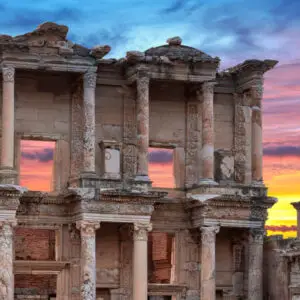
| The Library of Celsus | Completed in 117 AD, it once stored 12,000 scrolls and remains the most iconic image of Ephesus. |
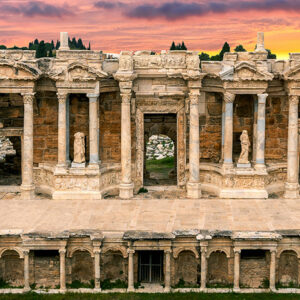
| The Great Theater | With a capacity of 25,000, it hosted gladiatorial games and drama, and was the site of St. Paul’s sermons. |
| Temple of Artemis | Known as one of the Seven Wonders of the Ancient World, this massive temple was the spiritual heart of the city. |
| The Terrace Houses | These “houses of the rich” feature exquisite mosaics and frescoes, offering a glimpse into the private lives of Roman elite. |
Did You Know?
A Moving Coastline: Ephesus was once a thriving port city. However, over centuries, the silt from the Cayster River (Küçük Menderes) filled the harbor, pushing the Aegean Sea 6 kilometers away.
The First Advertisement: Carved into the marble road is a footprint and a figure, widely considered to be the world’s first “advertisement” pointing the way to a local establishment.
Philosophical Roots: The city was the birthplace of the famous philosopher Heraclitus, known for his doctrine that “change is the only constant.”
Travel Tips for Visitors
To make the most of your visit to this ancient wonder:
Timing: Start your tour early in the morning or late in the afternoon to avoid the midday sun and large crowds.
Guided Tours: Hiring a professional guide is highly recommended to understand the complex history behind the ruins.
The House of the Virgin Mary: Located just a few kilometers away on Mt. Koressos, this shrine is believed by many to be the final home of Mary, the mother of Jesus.
“Ephesus is not just a collection of ruins; it is a bridge between the ancient world and the modern day, inviting us to walk the same paths as emperors, philosophers, and saints.”